Meeting Children's Individual Needs
“Help me do it myself”
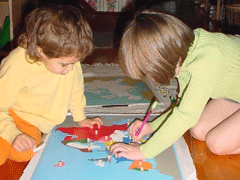
Our unique program encourages children to learn at their own pace. The toddler class age ranges from 12 months to 30 months. The preschool class ages ranges from 2 ½ to 6 year olds.
A mixed-age group working together provides indirect preparation for younger children, who watch and begin to absorb the activities they will be doing later, and it helps the older children realize their progress when they see younger ones attempting things that they themselves mastered some time ago.
The general social atmosphere of a mixed age group benefits from children helping and learning from one another, as it becomes a fact of life that some people are more experienced in some things, but that everyone needs a little help from others.
Creating a classroom for every child:
Gardner's Theory of Multiple Intelligences
“The Multiple Intelligences Theory is a scientifically supported system of classifying human abilities, and suggestions about how to encourage learning in ways that respect the individual interests and strengths of children. This theory in early childhood classes usually offers a greater variety of materials and helps ease children into materials which they may find threatening.”
Howard Gardner
Listed below are Gardner's Theory of Multiple Intelligences and some ideas on how teachers here at Leaside Children's House nurture these “intelligences”.
MUSICAL – The ability to produce and recognize simple songs; play with these melodies, varying speed and rhythm.
-
How we nurture these abilities: We incorporate music daily. We use a tape recorder for listening, singing along, and recording songs and rhythmic and melodic instruments.
LOGICAL/MATHEMATICAL – The ability to understand the basic properties of numbers, adding or subtracting; appreciate principals of cause and effect, one-to-one correspondence; ability to predict (such as which objects will float, sink, etc.)
-
How we nurture these abilities: We provide manipulative to help children experiment with numbers; use simple machines to help children think about cause and effect.
INTERPERSONAL – The ability to understand other people and work effectively with them and to notice who plays with who at school, and why.
-
How we nurture these abilities: We give children lots of opportunities to talk about one another and their social interactions, and to problem-solve conflicts together; play games in which one has to figure out the knowledge or intentions of other players.
INTRAPERSONAL – The ability to understand things about oneself, how one is similar to, different from others; remind oneself to remember to do something; know how to soothe oneself when sad.
-
How we nurture these abilities: We let children express their emotions, preferences and strategies. We help them understand their own wishes and fears and how best to deal with them.
BODILY/KINESTHETIC – The ability to use the body or parts of the body to solve problems, as in playing a ballgame, dancing, or making things with the hands.
-
How we nurture these abilities: We provide opportunities for physical challenges throughout the day-not just outdoors.
LINGUISTIC – The ability to use language to express meaning, understand others, tell a simple story; react appropriately to stories with different moods; learn new vocabulary or a second language that is used naturally.
-
How we nurture these abilities: We make sure that we provide lots of language opportunities and that children's linguistic expression is listened to and appreciated.
SPATIAL – The ability to be able to form a mental image of large (a home) and local (a block building) spatial layouts; find one's way around a new building.
-
How we nurture these abilities: We provide many opportunities for mapping of the classroom and beyond. We explore new spaces and encourage children to vary the arrangements of materials in the space.
NATURALIST – The ability to recognize species of plants and animals in one's environment; for example, to learn the characteristics of different birds.
-
How we nurture these abilities: We play games in which children recognize fine distinctions among members of a plant or animal group; explore the outdoors regularly and bring the outdoors in; provide books, visuals, and props related to the natural world.
“It is more important to discover areas of strength and to build on them than it is to fret too much about areas of weakness.”
Howard Gardner